
Eileen Higgins, Miami’s first female mayor
Eileen Higgins, Miami’s first female mayor — breaking the mold and steering a city in transition
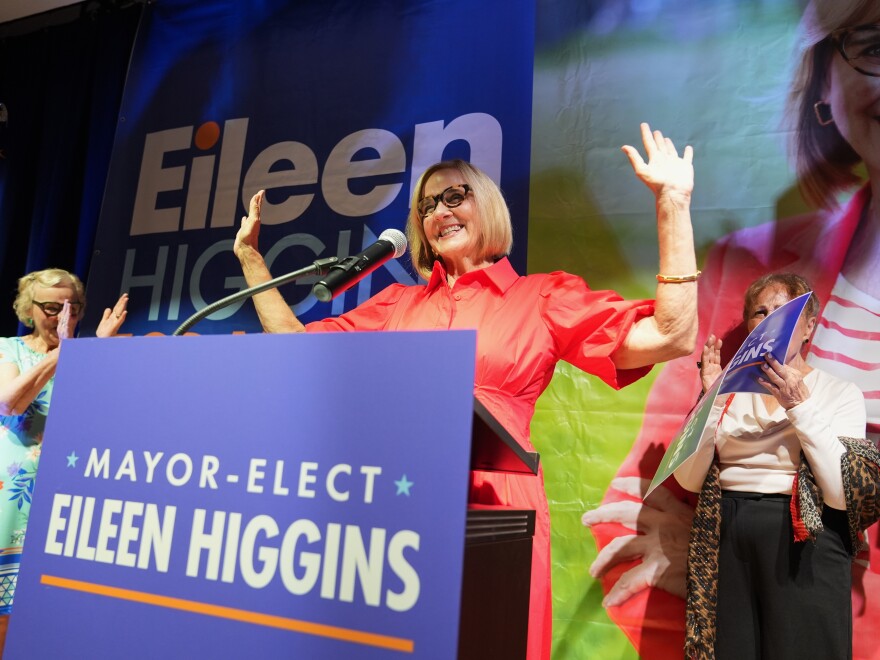
Miami’s first female mayor – Eileen Higgins: When strode onto the stage on election night
the cheers that greeted her were more than the payoff of a well-run campaign. They marked a turning point in Miami politics: Higgins became the city’s first female mayor, the first Democrat in the office in nearly three decades, and the first non-Hispanic to hold the post since the 1990s — a symbolic and practical shift in a city that has long been a bellwether for broader demographic and political changes. Her decisive runoff victory over Emilio González capped a race watched closely by national strategists and local residents alike.
From engineer to public servant: the arc of a pragmatic leader
Eileen Higgins’s path to City Hall is not the standard New York-to-Washington political trajectory. Born in Ohio and raised in Albuquerque, New Mexico, she trained as an engineer, earning a Bachelor of Science, and later completed an MBA. Early in her career she turned her technical training and interest in infrastructure into international development work: positions in the Peace Corps and as a foreign service officer focused her on transportation, economic development, and community-level capacity building in Latin America and beyond. Those formative experiences framed a technocratic, problem-solving approach she brought to local government after moving to Miami in the early 2000s.
Higgins entered electoral politics in 2018 when she won a special election to the Miami-Dade County Commission representing District 5. She was re-elected in 2022 and ran unopposed in 2024; during her time on the commission she chaired transportation committees and championed initiatives on affordable housing, transit expansion, and climate resilience. Her record emphasized pragmatic wins — funding for transit projects, efforts to streamline permitting, and investments aimed at reducing the affordability gap — all themes that would feature centrally in her mayoral platform.
A campaign shaped by local problems, national implications
Though Miami’s mayoral contests are officially nonpartisan, Higgins ran with the clear backing of the Democratic Party and national progressive infrastructure — an alignment that became more salient as the race intensified. She qualified for the ballot by petition, an early display of grassroots capacity, and positioned herself as a candidate focused on everyday concerns: reducing bureaucratic gridlock at City Hall, improving public safety, expanding affordable housing, accelerating climate adaptation projects, and reforming permitting so small businesses and residents could more easily get things done. Her message was both local and practical: “make City Hall work for us” — a pitch meant to resonate across neighborhoods that feel the pinch of rising costs and rising seas.
The 2025 mayoral race nevertheless took on outsized national meaning. Miami had trended toward Republican candidates in recent cycles and is a Hispanic-majority city whose electoral behavior has been closely scrutinized by both parties. Higgins’s opponent, Emilio González, drew high-profile endorsements from national Republican figures. That the contest became a referendum of sorts on national rhetoric around immigration and governance amplified the stakes — and the attention — even as Higgins insisted her agenda would remain focused on city services and resident affordability.
Winning decisively: numbers and narratives
Higgins led the field in the first round of voting and then won the December runoff convincingly, capturing roughly 59% of the vote to González’s 41% in preliminary tallies — a margin that surprised some political watchers who had expected a closer fight in a city long dominated by Republican mayors. Local and national outlets framed the result as a dual victory: the election of Miami’s first female mayor and the reclamation of City Hall by Democrats for the first time since the late 1990s. For supporters, it was a repudiation of a politics of fear and division; for opponents, it was a sign of shifting terrain in a city undergoing rapid demographic, economic, and cultural change.
Policy priorities: fix the plumbing, then build the future
Higgins’s mayoralty is expected to emphasize institutional repair as much as policy innovation. She campaigned on making government more efficient and transparent — streamlining permitting processes, tightening financial oversight, and rebuilding trust in local institutions after years that many voters described as chaotic. That “plumbing first” approach reflects her engineering and operations background: systems should work before they can be improved. Her record on the county commission — from supporting the Better Bus Network and trolley expansions to funding affordable housing projects — offers a blueprint for the kinds of pragmatic, deliverable projects she will likely prioritize as mayor.
Climate resilience also looms large on Miami’s municipal agenda, and it is an area where Higgins has positioned herself as a capable manager. With sea-level rise an existential challenge for coastal neighborhoods, city leadership must coordinate infrastructure investments, zoning decisions, and federal, state, and local funding streams — tasks that reward managerial competence and cross-jurisdictional partnerships. Higgins’s campaign promised that focus, and voters appeared to reward that demonstration of competency.
Affordable housing and affordability more broadly are similarly central. Miami’s boom in high-end development has pulled up prices, straining long-term residents and workers. Higgins campaigned on accelerating the creation of housing units tied to transit and on using the tools available at city and county levels to preserve and expand housing affordability. Her practical track record in county government lends credibility to those promises, but delivering at city scale will require navigating complex politics, private development interests, and limited public resources.
Representation and symbolism — why this matters
Symbolism matters in politics. Electing Miami’s first female mayor sends a strong message about representation in a city where leadership has historically reflected particular ethnic and gender dynamics. Higgins’s win is also a marker in the national story of political realignment: Democrats showing they can win in diverse, Hispanic-majority urban centers that in recent years have been contested terrain. For many residents, her election was an affirmation that local governance can be reclaimed for pragmatic, resident-centered problem solving rather than nationalized culture-war battles.
At the same time, the symbolic firsts must be matched by measurable improvements in residents’ lives. The expectations on a mayor who is both the “first” and the “change agent” can be high; delivering will require coalition building across Miami’s varied communities, from long-time neighborhood groups to new arrivals drawn by Miami’s economic dynamism. Higgins will need to prove that representation can produce results — better transit, safer streets, more affordable homes, and strengthened climate defenses — rather than merely a new face at the podium.
Challenges ahead: politics, governance, and expectations
The early partisan framing of a nonpartisan race means Higgins will have to carefully manage national expectations while governing locally. Miami’s mayor has significant ceremonial influence and agenda-setting power, but the city’s machine includes powerful developers, state-level actors, and county institutions whose cooperation is often essential. She will inherit a city wrestling with inequality, climate vulnerability, and strained civic infrastructure. That reality means compromise and incremental wins will likely define her first term; the voters who lifted her into office will expect tangible improvements, and the political opposition will be ready to capitalize on any perceived missteps.
Finally, Higgins must translate campaign promises into a fiscal and administrative plan. Whether funding for resilience projects, housing subsidies, or transit expansions, the money must come from somewhere — and that will require smart financial stewardship and often, new partnerships with federal and state programs. Her background suggests she understands that interplay between technical design and political feasibility — but the test will be in the delivery.
Looking forward: a mayor for a changing Miami
Eileen Higgins’s election is a clear marker of change in Miami. It is a story about representation — a woman, a Democrat, and a leader who rose through county government — but it is also about governance: voters endorsed a platform of practical solutions to deep, structural problems. Her success will be measured not only by the symbolic milestones she represents, but by whether she can make City Hall more efficient, protect neighborhoods from climate threats, expand affordable housing, and restore faith in local government.
Miami in 2025 is a city in transition, economically vibrant but socially bifurcated, globally connected but locally challenged. Higgins’s tenure will be an experiment in whether managerial competence, coupled with an inclusive political vision, can deliver the kind of day-to-day improvements that matter most to residents. If she succeeds, the election will be remembered as more than a historical footnote; it will be the moment Miami chose a new direction. If she falters, the lesson will be about the limits of symbolism without sustained governance.
Either way, Eileen Higgins’s mayoralty begins with high expectations and hard work — and a city watching closely as one of its most consequential leaders tries to turn campaign promises into durable public good

Leave a Reply